Caregiving already requires attention, judgment, patience, and constant adjustment.
A caregiver may be helping with routines, appointments, communication, transportation, health needs, household responsibilities, community participation, and unexpected changes throughout the day. Professional support teams are also documenting services, coordinating across shifts, communicating with families, and responding to multiple priorities at once.
Technology is often introduced with the promise of making this work easier. But when it is poorly designed or added without a clear purpose, it creates more notifications, more screens, more passwords, and more information to sort through.
Good technology should not ask caregivers to become full-time system administrators. It should help them understand what matters, recognize when something has changed, and respond with greater confidence.
Caregivers do not need more information. They need clearer information.
More data does not automatically create better support.
A caregiver may receive information from mobile applications, wearable devices, environmental sensors, schedules, service records, health tools, family members, and other members of the support team. Each source may be useful on its own, but the overall picture becomes difficult to understand.
The challenge is not collecting information. The challenge is helping caregivers distinguish what is normal for the person, what may be changing, what needs attention now, what can be reviewed later, and who needs to be informed.
Technology should organize this information around the person’s typical routines, preferences, and support plan. A caregiver should not have to examine several separate systems to determine whether something meaningful has happened.
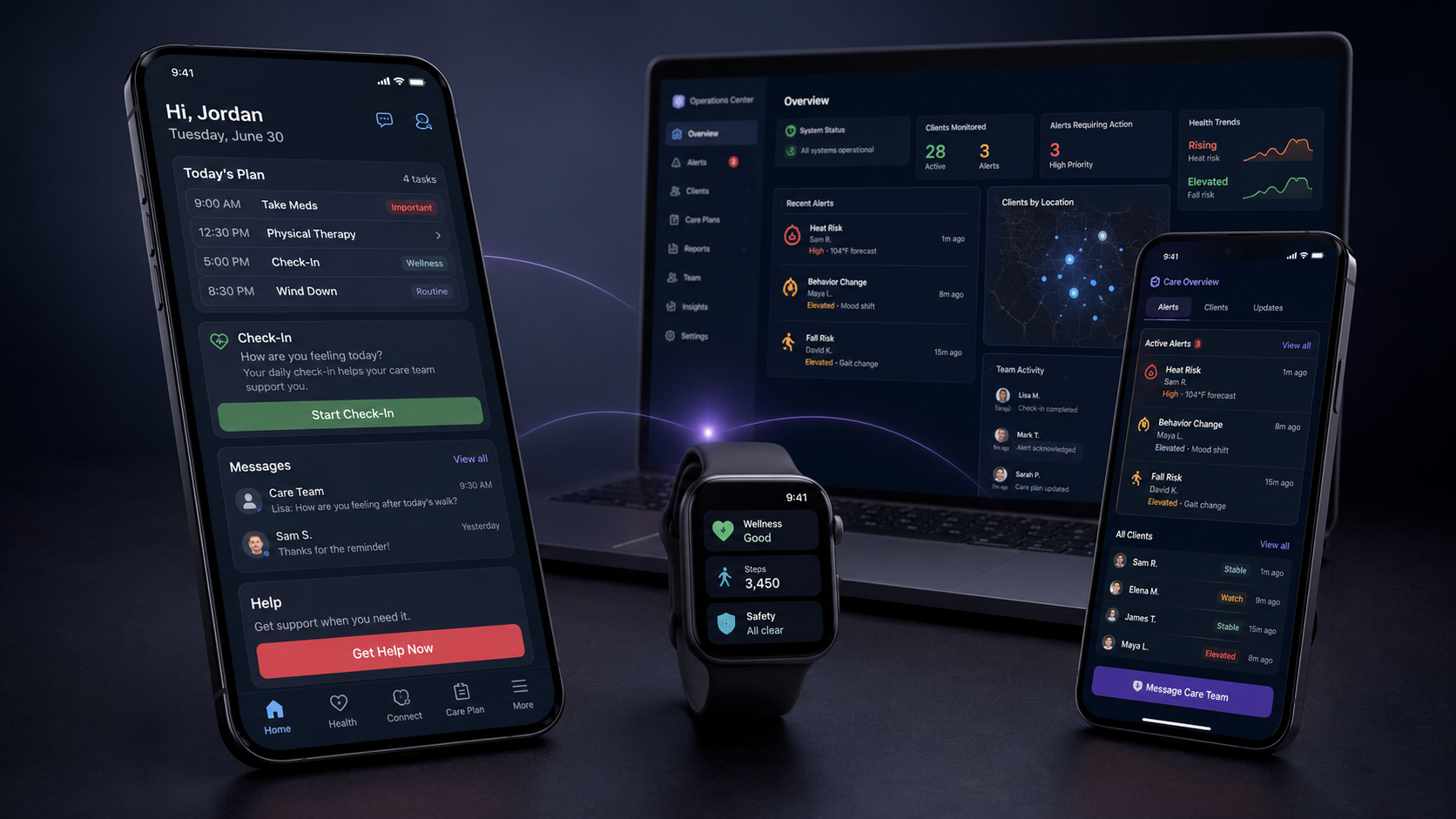
This is the thinking behind Nora Caregiver Intelligence within the GMA MyCompass System. A single observation rarely tells the whole story. When permitted information is organized across time and in relation to the person’s routines, environment, and support plan, caregivers gain a clearer view of what deserves attention and what may simply reflect ordinary variation.
More data is not the goal. More useful understanding is.
The goal is less guesswork
Caregiving often involves noticing small changes. A person may sleep differently, miss part of a routine, become less active, communicate differently, or respond in a way that is unusual for them. None of these observations automatically means something is wrong, but together they may provide useful context.
Technology can help caregivers see patterns that are otherwise difficult to catch. Has this happened before? Is it different from the person’s usual routine? Did anything else change around the same time? Has another caregiver already documented a concern? Is there an agreed-upon response in the person’s plan?
This does not replace caregiver knowledge or professional judgment. It gives caregivers better context for the decisions that remain theirs to make. A useful notification explains what was observed, why it may be relevant, whether it differs from the person’s usual pattern, and what response is already included in the support plan — without pretending to make decisions that belong to the person, the caregiver, or a qualified professional.
Notifications should be meaningful — and reach the right person
A system that alerts caregivers about everything will eventually make it harder to recognize what truly matters. When every event appears urgent, nothing feels urgent.
Notifications should reflect the individual, the situation, and the level of response needed. A routine update should not look the same as a significant safety concern. Support teams benefit from distinct levels of communication:
- A quiet update that can be reviewed later
- A change that should be watched
- A concern that requires caregiver attention
- A significant event that should be escalated
- An emergency that requires immediate action
Just as important, information should go to the right person. Not every caregiver, family member, case manager, or administrator needs every update. Within the MyCompass System, visibility is governed by role, permission, consent, purpose, and need — CompassCare brings role-appropriate alerts, secure communication, and context to caregivers and support teams, while CompassCare Command Center gives provider organizations coordinated visibility across people, programs, and operations without giving everyone the same view. You can read more about how these boundaries are engineered on our Security page.
Role-based communication reduces unnecessary interruptions while ensuring important information reaches the people responsible for responding.
Continuity between caregivers
People often receive support from more than one person. Family members, direct support professionals, nurses, case managers, therapists, and other trusted individuals may each understand a different part of the person’s life.
When communication is fragmented, a caregiver may begin a shift without knowing what happened earlier in the day. Families repeat the same information to several people. Small but important details get lost between conversations.
A coordinated system creates continuity by making relevant information easier to review: changes in routines, recent safety concerns, completed activities, missed reminders, upcoming appointments, follow-up actions, and notes from other members of the team.
The purpose is not to replace conversation. It is to help each conversation begin with a clearer understanding of what has already happened.
The responders should be the people who know the person
Gray Matters Alliance is not a call center, and we do not place one between a support team and the people they serve.
Instead, we equip families, caregivers, guardians, support teams, and provider organizations to be the responders themselves. When a concern is surfaced or a request for help goes out, it reaches the people who already know the person, understand their preferences, and carry responsibility for their support — not a stranger reading from a script.
Technology supports awareness. People remain responsible for interpretation, decisions, and action.
The person must remain at the center
Reducing caregiver burden should never come at the cost of the individual’s privacy, dignity, or independence. This is more than good practice: it reflects the person-centered planning requirements of the federal HCBS Settings Rule, which protects the autonomy, privacy, and dignity of people receiving Medicaid home and community-based services — requirements that waiver-funded providers already operate under.
Technology should not be used simply because monitoring is possible. Every feature should serve a clear purpose connected to the person’s goals, support needs, or safety plan. Support teams should ask what information is actually necessary, who should be allowed to see it, whether the individual understands how the technology is being used, and whether the level of support can change throughout the day.
Sometimes the right response is an immediate alert. Other times it is a quiet reminder, a summary for later review, or no interruption at all. A person-centered system provides support without treating every part of a person’s day as a problem to be monitored.
Implementation matters as much as the technology
Even a well-designed system becomes burdensome if it is introduced without training or follow-up.
Caregivers need to understand what the technology does and does not do, which notifications they will receive, how they are expected to respond, how to adjust settings, who to contact when something is not working, and how the person’s privacy and preferences are protected. Training should reflect the caregiver’s role — a family member needs different information than a direct support professional or an organizational administrator.
The system should also be reviewed after it has lived in the real world. Are caregivers receiving too many notifications? Is a feature creating unnecessary work? Has the person’s routine or support need changed? Our involvement does not end at deployment: monthly outreach, role-appropriate education, and scheduled follow-up mean the system is adjusted based on real experience, rather than expecting the support team to work around something that no longer fits.
The best technology gives time and attention back
Caregivers should be able to spend more time supporting people and less time searching through disconnected information.
The right technology brings relevant information together, reduces repetitive documentation, clarifies what needs attention, supports communication across the team, escalates concerns to the appropriate person, and quietly handles routine information in the background.
The result should not be more technology in the caregiver’s day. It should be more clarity.
At Gray Matters Alliance, we begin by understanding the individual, the people supporting them, and the environment in which daily life happens. From there, technology, equipment, training, and ongoing support are coordinated around what is genuinely useful — because the goal is not to give caregivers one more thing to manage. The goal is to help them feel more informed, more connected, and better supported in the work they are already doing.
Start a conversation
Looking for technology that supports both the individual and the people around them? Gray Matters Alliance works with individuals, families, caregivers, and organizations to develop person-centered solutions that fit everyday life.
Start Your Journey or discuss organizational access.
Related reading: 5 Signs It May Be Time to Consider Remote Support · Independence, Technology, and What a Good Day Looks Like